
10 Reasons Beijing Is Well-Positioned to Withstand—and Capitalize on—the U.S. Tariff Offensive
By: Ashkan Shekarchi, PhD
In early April, President Donald Trump declared a symbolic economic “Liberation Day,” casting the move as a corrective to years of unfair trade practices, a catalyst for manufacturing revival, and a step toward bolstering resilience and easing mounting fiscal pressures. The declaration was swiftly followed by across-the-board tariffs on goods targeting nearly all U.S. trading partners—China bore the brunt, with duties starting at 34 percent and climbing to 145 percent through successive rounds of retaliatory escalation. The move aligned squarely with Trump’s longstanding economic worldview—evident in his boast that “trade wars are good, and easy to win,” and in his belief that tariffs—his “most beautiful word in the dictionary”—are potent tools of statecraft to extract concessions and secure geostrategic gains.
Unprecedented since the Smoot-Hawley Tariff Act of 1930—infamous for sparking a global trade war and exacerbating the Great Depression—Trump’s disruptive tariff blitz marks a sharp departure from the post-1970s embrace of economic globalism and decades of U.S. commitment to free trade. Markets and households were rattled, as the sudden escalation sowed uncertainty across global supply chains and investor confidence wavered. Governments worldwide scrambled to decide whether to retaliate, adapt, or wait out Washington’s economic offensive.
Beijing, however, refused to bow down or blink. Chinese officials vowed to “fight to the end,” launching a deliberate, multi-phase retaliation campaign that eventually imposed duties of up to 125 percent on U.S. goods. Far from retreating, China signaled its readiness to absorb the shock, recalibrate, and even leverage the disruption to its long-term strategic advantage. What follows are ten key reasons Beijing is well-positioned to weather and capitalize on Trump’s trade offensive.
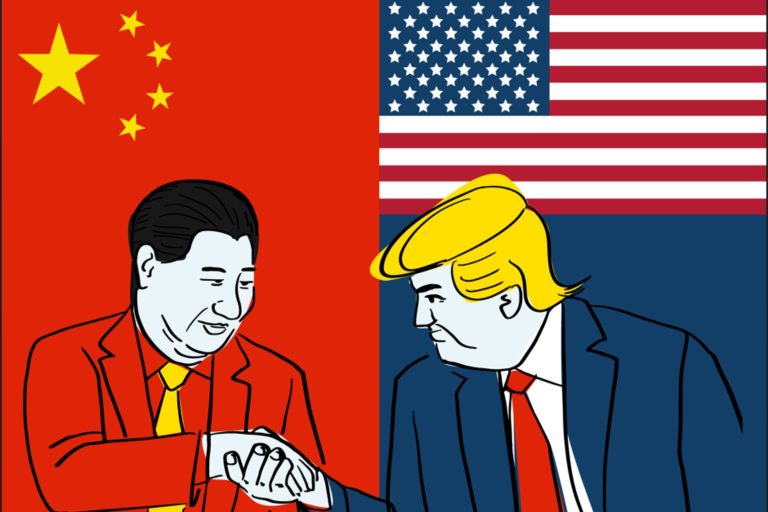
1. Industrial and Trade Preeminence Gives Strategic Depth: China enters the trade war not as a vulnerable rival, but as the world’s manufacturing hub. With 35 percent of global industrial output—nearly triple America’s 12 percent—Beijing is leading the Fourth Industrial Revolution, backed by a comprehensive industrial ecosystem with the world’s most advanced supply chain. By 2030, its share is projected to hit 45 percent, while the U.S. stagnates at 11 percent. That industrial heft offers insulation against tariffs and the flexibility to redirect trade flows.
In 2024, China exported $3.377 trillion in goods—62 percent more than the United States’ $2.084 trillion—making it the top trading partner for 120 countries and the second largest for key U.S. allies, including the EU, Canada, and Mexico. With a $37 trillion economy in purchasing power parity terms—compared to $28.8 trillion for the United States—Beijing brings scale and leverage that few countries can match—and that Washington struggles to contain.
2. Proactively Diversified and Strategically Self-Relied: Having learned from Trump’s first-term trade war, President Xi Jinping pivoted away from optimism and personal diplomacy in favor of structural resilience—recognizing that China would need to proactively shield its economy from future shocks by reducing dependence on the U.S., diversifying trade partners, investing in critical technology self-reliance, and deploying tariff circumvention tactics to blunt external pressure.
That strategic shift is now reflected in the numbers. The U.S. share of China’s exports has fallen steadily, from 42 percent in 1999 to 22 percent in 2018, and just 13 percent in 2024—a four-decade low. In absolute terms, China’s exports to the U.S. totaled $439 billion in 2024, representing just 2.37 percent of its nominal GDP; even with services included, total bilateral trade accounts for only 3.58 percent of the Chinese economy.
To insulate further, China shifted trade flows, expanded its export footprint, and employed tariff-deflection tactics such as transshipment and re-routing through third countries. The same applied to import substitution—notably replacing U.S. soybeans, beef, and pork with supplies from Brazil, Australia, and Europe, respectively. Yet, rather than pursue outright economic decoupling, Beijing has opted for targeted self-reliance in critical technologies and sectors. The result is a more shock-resistant posture, calibrated to absorb short-term pain for long-term geostrategic gain.
3. Wielding a Multifront Trade-War Arsenal: China has built and mobilized a potent arsenal of retaliatory tools to counter Washington’s tariff offensive. Chief among them is its near-monopoly over heavy rare-earth minerals and magnets—critical to sectors ranging from automotive and semiconductors to energy, aerospace, and defense. In response to U.S. escalation, Beijing has restricted exports of key minerals and components, weaponizing supply chains vital to America’s high-tech industries—a move with minimal financial cost to China but outsized strategic impact.
But Beijing’s leverage extends well beyond industrial inputs. As the second-largest holder of U.S. Treasury bonds—with $760 billion in securities—Beijing could, in theory, dump its holdings to spike U.S. interest rates and devalue the dollar. Though mutually damaging, it remains a credible threat in China’s financial arsenal. Moreover, Chinese authorities have also rolled out a suite of punitive measures targeting U.S. firms, including export bans on dual-use items and blacklisting select companies as “unreliable entities.” Several American firms operating in China have also been hit with regulatory and antitrust investigations, signaling Beijing’s readiness to escalate pressure beyond tariffs alone. China also holds softer levers, from market access to public sentiment, to turn against U.S. brands if needed.
4. Holding the Home-Front Advantage: China’s internal conditions give it a structural edge in absorbing economic shocks and sustaining a drawn-out trade war. Its one-party system enables swift, coordinated policy shifts without the drag of partisan gridlock, while its state-managed economy can directly support and stabilize vulnerable sectors. China benefits from a stable domestic environment—reinforced by strong nationalist sentiment, a collectivist culture, and a public more accustomed to economic hardship. Politically, Beijing faces no serious opposition or electoral deadlines constraining its strategic horizon. These sociopolitical foundations are matched by formidable economic buffers. With a sky-high savings rate—44.3 percent of GDP—vast foreign exchange reserves, and status as the world’s top lender, Beijing is well-equipped to weather sustained external pressure. And with a more flexible currency regime, the People’s Bank of China can adjust the yuan far more nimbly than the U.S. Federal Reserve to blunt tariff impacts when necessary.
5. Surplus Yields Strength: In a trade confrontation, the surplus country holds the upper hand: it forfeits income, not essential goods, while the deficit country risks losing access to critical, often irreplaceable imports. In 2024, China posted a $295 billion trade surplus with the U.S. and a staggering $992 billion globally. This gives Beijing room to absorb losses by diverting exports, tapping into domestic demand, or drawing on excess savings. The U.S., by contrast, risks shortages of goods and industrial inputs it no longer produces competitively, making adjustment slower and costlier. A trillion-dollar surplus economy has flexibility and financial firepower; a deficit economy has dependence—and therefore, greater vulnerability. After all, enduring trade deficits are the trade-off for reserve currency privilege.
6. America First Led to America Alone: Trump’s one-against-all trade war has turned “America First” into “America Alone,” isolating Washington and eroding trust in the U.S. as a reliable, rules-based economic partner. By waging onerous tariffs not just on rivals but also on its closest allies and partners, the U.S. has undermined its own alliance system—long its greatest strategic advantage over China. America’s actions have forced friends into difficult choices, fostered resentment, and squandered trust built over generations. From backtracking on trade deals like USMCA to sidelining global trade norms and degrading the multilateral trading system, Washington’s erratic policymaking has delivered substantial windfalls to Beijing. After straining alliances by questioning allies’ sovereignty and security commitments, Trump’s trade offensives have further corroded the very alliance system that underpinned U.S. global primacy. In doing so, the U.S. is effectively shooting itself in the foot—handing China a geostrategic gain.
7. Beijing Moves as Washington Retreats: China views Trump’s go-it-alone trade war as a timely opening to exploit the fissures Washington has created within the Western bloc and to benefit from a reordering of global trade. Guided by the maxim “never let a good crisis go to waste,” Beijing is leveraging the disruption of Trump’s all-front tariff crusade to diversify its trading partners and deepen cross-regional cooperation.
A few illustrative moves already reveal the contours of this broader strategy. China, Japan, and South Korea have agreed to accelerate talks on a trilateral free trade agreement and boost cooperation on supply chains and export controls. In Europe, the upcoming EU-China summit—marked by European leaders traveling to Beijing—signals a renewed effort to re-engage with China. Meanwhile, Xi’s recent tour of Southeast Asia aims to consolidate regional ties and expand China’s economic footprint. Global trade, after all, will move on—with or without the Uncle Sam.
8. Pride at Home, Prestige Abroad: Xi remains resolute, while China projects quiet strength. Domestically, China’s firm retaliation by reciprocating U.S. tariffs and deploying a range of nontariff measures has boosted national pride and strengthened the image of President Xi and the Communist Party as tough and unyielding under American pressure. By matching rhetoric with action, Beijing signals it won’t be cowed, earning admiration and a renewed sense of pride at home. The U.S. offensive is widely seen as reminiscent of bullying during the Century of Humiliation, turning this trade standoff into a test of national dignity.
Internationally, meanwhile, China is projecting itself as a rational and principled power that occupies the moral high ground. Xi has urged Europe to “jointly safeguard the trend of economic globalization and a fair international trade environment, and jointly resist unilateral and intimidating practices.” This appeal highlights Beijing’s effort to present itself as a benevolent defender of the rules-based multilateral system and raise its global prestige. The stance has drawn global sympathy and encouraged realignment among U.S. allies disillusioned by Washington’s confrontational approach.
9. Squandered Leverage, China’s Advantage: Amid the return of great-power rivalry and Washington’s embrace of a containment strategy, the U.S. launched an all-out tariff war against China—only to exhaust a key source of leverage without securing strategic concessions. This squandered card was one of Washington’s most potent assets—now rendered ineffective through premature and unilateral escalation. By acting without allied coordination, the U.S. turned a potential strategic advantage into a self-damaging move, weakening its coercive power and emboldening Beijing.
Likewise, the U.S. exhausted the tech war as part of its broader containment strategy—only to see it falter. Chinese leadership has largely achieved the goals of Made in China 2025, its blueprint for upgrading high-tech, strategic industries. With both the trade and tech war campaigns now behind it, Beijing has withstood U.S. pressure, while turning each confrontation into a proving ground. The inability to secure a decisive strategic gain on either front is steadily diminishing Washington’s broader effort to check China’s broad-based rise.
10. A Strategic Gift Wrapped in Failure: Trump’s poorly crafted, misguided policy is appearing inherently self-defeating—the easiest kind for a peer rival like China to overcome. His erratic, sweeping trade war exposes several major shortcomings. First, its intended goals—reviving U.S. manufacturing, generating massive tariff revenues, and rebalancing U.S. trade—are largely unrealistic. Manufacturing recovery cannot be jumpstarted by decree; it requires decades of investment, a skilled workforce, reliable supply chains, and above all, an effective, long-term industrial policy, which remains absent. Nor do tariffs deliver on their economic promises; they merely redirect trade and provoke retaliation, undercutting both revenue gains and rebalancing efforts. Second, the policy overestimates America’s unilateral economic leverage while underestimating other nations’ ability to counter and adapt. Third, it provokes confrontation without first securing the necessary foundations at home—effectively waging an economic war without arming itself. And finally, the policy fails to account for the inflationary costs and disruptions it imposes on American consumers and manufacturers, fueling widespread economic discontent and uncertainty. As a result of mounting pressure from Wall Street, tech giants, and business lobby groups, Trump has begun to retreat—delaying, narrowing, and scaling back his tariff plans. All of this underscores Trump’s inability to sustain or escalate the offensive—making it easier for China to neutralize his miscalculated and ill-executed policy.
In closing, Trump launched the tariff offensive without a sound grand strategy, striking indiscriminately, then surveying the fallout. All in with a losing hand, he unleashed a trade crusade that is not easy to end—failing yet again to anticipate the unintended consequences that cost America dearly. History and economics offer little support for such an ill-conceived move—one that also weakened America’s alliance system and credibility, furthering the erosion of its global power. A more viable and strategic approach would have begun by reinforcing the domestic foundation and working with allies—who together account for two-thirds of the global economy—to present a unified front in pressing China for fairer trade and broader concessions. By contrast, Beijing has been playing the long game, now holds escalation dominance, and is positioning itself to emerge stronger from a confrontation Trump never fully fathomed.